Visiting Fellow in International and Public Affairs Marc Dunkelman’s book “Why Nothing Works: Who Killed Progress—And How to Bring It Back” explores the architecture of power and how to restore confidence in democratically elected government.
 America is today the victim of a vetocracy that allows nearly anyone to stifle progress. While conservatives deserve some blame, progressives have overlooked an unlikely culprit: their own fears of “The Establishment.” A half-century ago, progressivism’s designs on getting stuff done were eclipsed by a desire to box in government. Reformers put speaking truth to power ahead of exercising that power for good. The ensuing gridlock has pummeled faith in public institutions of all sorts, stifled the movement’s ability to deliver on its promises, and, most perversely, opened the door for MAGA-style populism.
 Inflation is back, and its impact can be felt everywhere, from the grocery store to the mortgage market to the results of elections around the world. What's more, tariffs and trade wars threaten to accelerate inflation again. Yet the conventional wisdom about inflation is stuck in the past. Since the 1970s, there has only really been one playbook for fighting inflation: raise interest rates, thereby creating unemployment and a recession, which will lower prices. But this simple story hides a multitude of beliefs about why prices go up and how policymakers can wrestle them back down, beliefs that are often wrong, damaging, and have little empirical basis.
 Crowded Out delves into the complex landscape of international non-governmental organizations (INGOs). Bush and Hadden trace INGOs' rise to prominence at the end of the twentieth century and three significant but overlooked recent trends: a decrease in new INGO foundings, despite persistent global need; a shift toward specialization, despite the complexity of global problems; and a dispersal of INGO activities globally, despite potential gains from concentrating on areas of acute need. Assembling a wealth of new data on INGO foundings, missions, and locations, Bush and Hadden show how INGOs are being crowded out of dense organizational environments. They conduct case studies of INGOs across issue areas, relying on dozens of interviews and a large-scale survey to bring practitioners' voices to the study of INGOs. To effectively address today's global challenges, organizations must innovate in a crowded world. This title is also available as open access on Cambridge Core.
 This book answers the key questions about how illicit global markets are structured and operate, how they intersect with state institutions and practices, how they interact with the legal economy, and how they shape and are shaped by domestic and international politics. This pithy yet authoritative primer helps readers make sense of a crucial part of the global economy that is too often either neglected or distorted. In this regard, an underlying theme in the book is the need for a more historically informed critical perspective that challenges the many myths and misconceptions about the illicit global economy that are all-too-prevalent in contemporary media accounts, Hollywood depictions, popular books, and policy debates.
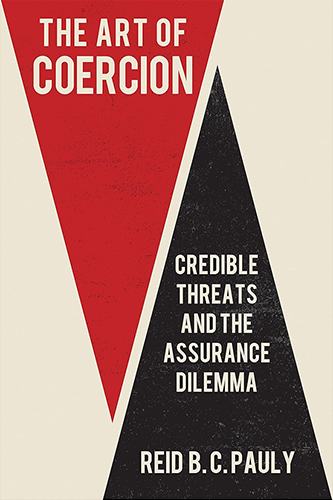 Strong states are surprisingly bad at coercion. History shows they prevail only a third of the time. Pauly argues that coercion often fails because targets fear punishment even if they comply. In this “damned if you do, damned if you don’t” scenario, targets have little reason to obey.