Student Spotlight: Bruna da Silva Melo ’26

Senior International and Public Affairs (IAPA) concentrator Bruna da Silva Melo found the perfect vehicle for community building in the Watson School’s Africa Initiative.

Brown senior Bruna da Silva Melo, an International and Public Affairs (IAPA) concentrator, grew up in Angola, Portugal and the United States. Her mother and father were both born and raised in Angola. 

Da Silva Melo said living in Angola shaped her identity in ways she only recently has come to appreciate. “Family is super important in Angola,” she said, “In Angola, every Saturday you have lunch with your entire family — your parents, your grandparents, your aunts and uncles, cousins, everybody — you can’t do work or hang out with friends or do anything else,” she said. 

Da Silva Melo admits she didn’t always appreciate being told to take a break from her life, especially her studies, to spend time with family, but her mother was firm about its necessity. “‘Bruna,’ she told me, ‘You can’t just be a good student. I want you to be a good person as well.’”

“Looking back, I realize she was right,” she said, “I couldn’t just focus on myself — my studies, my grades — it was important to see beyond that and connect with the people around me.”

That sense of the importance of community — as well as the centrality of her African identity — travelled with her to Brown. “A lot of the things I’ve done at Brown have been community-based,” she said, “I was able to see how valuable community is and focus on more than doing pre-professional things. It’s important to me to bring people together.” 

It was that desire to create a thriving community that led her to become the inaugural chair of the Watson School’s Africa Initiative Student Advisory Board.

“I didn’t actually know about the Africa Initiative until my sophomore year,” said da Silva Melo. While the program historically had strong ties to the undergraduate population, some of those ties were broken during the pandemic. “I served on the executive board of the African Students' Association (AfriSA). I was very involved in the African community at Brown and taking classes on Africa,” she said, “When I found out about the initiative, I went back to the board and said ‘We should do something with them.’”
Professor Smith was adamant about wanting to work with us. But beyond that, he really stressed the idea that it should be about amplifying our voices and bringing things to campus that African students want to see.

Bruna da Silva Melo IAPA Class of 2026
 
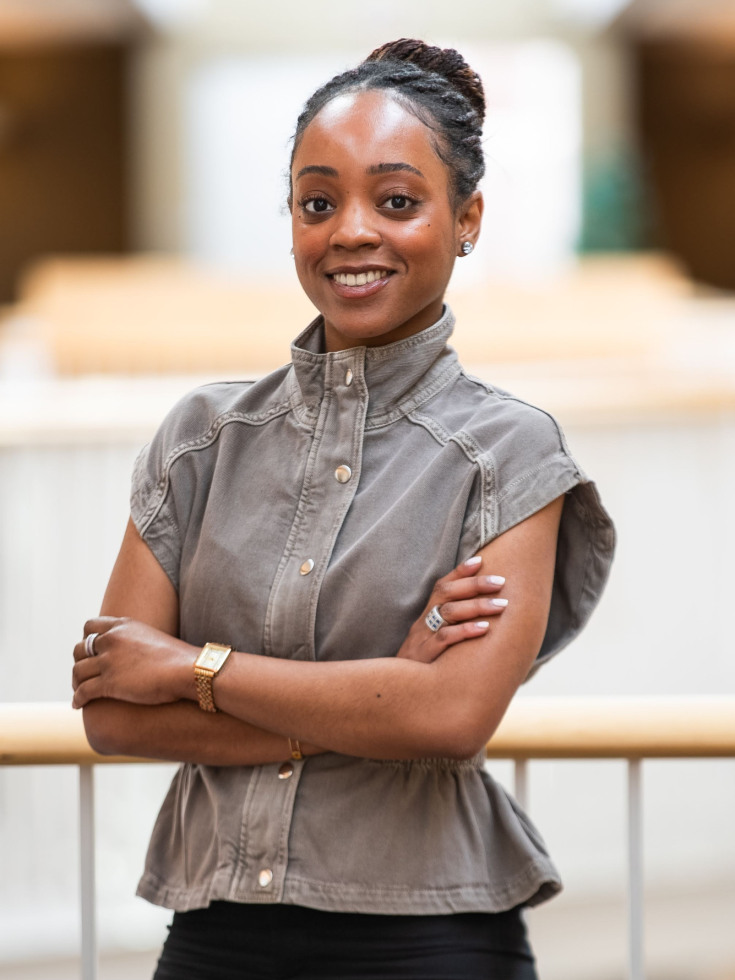
Headshot of Bruna da Silva Melo ’26

Da Silva Melo, along with a few other AfriSA students, met with Africa Initiative director Daniel Jordan Smith to discuss ways the two groups could collaborate. They found him more than open to the idea. “Professor Smith was adamant about wanting to work with us,” she said, “But beyond that, he really stressed the idea that it should be about amplifying our voices and bringing things to campus that African students want to see.”

One such event that she takes particular pride in was Ghana Synapse: Exploring Entrepreneurship in Ghana, a two-day event in February 2025 that connected Brown students with Ghanaian investors and thought leaders to explore Ghana’s emerging startup ecosystem. “We’ve also done a bunch of student-faculty events,” she said, “as well as an African Film and Arts Festival, and we’ve partnered with The Voice of Africa, a news organization based in Washington, D.C.”

Her Angolan identity has also helped shape da Silva Melo’s studies at Brown. For her IAPA sophomore seminar, she researched a topic dear to her, the complex interplay between Angolan popular music and national identity.

“I love Angolan music,” said da Silva Melo, “I listen to it every day.” But she noted that Angolan popular music is more than just a pleasurable listening experience for her and other Angolans because it has long had a strong political bent, anchored in the people’s experience of and resistance to colonialism. 

“One thing that is unique about Angola compared to other African countries,” said da Silva Melo, “is that we don’t speak our indigenous languages. Most of us speak only Portuguese.” Portuguese colonizers heavily suppressed indigenous languages during their rule, resulting in few Angolans today understanding more than a few words of them.

“But,” she said, “much of our popular music is sung in indigenous languages, so we sing and dance along to songs even though we have no idea what they are saying.”

She said this was the result of a conscious effort by young Angolan musicians during the colonial struggle to use music to forge a strong national identity in the face of colonial oppression. “The music became a way to protest the colonial regime,” she said, “because the Portuguese didn’t speak these languages, so they didn’t know what the musicians were saying.” Regardless of the lyrical content, the very act of singing in these languages was a form of protest and a way to connect Angolan listeners to their pre-colonial roots.

After graduating from Brown, da Silva Melo plans to attend law school. “My mom is a lawyer,” she said, “and I see the way her brain works, and it’s amazing. So, I want to go to law school, in part because I just enjoy the way lawyers think. I plan to study international law, and I’ve applied to schools that are strong in that.” 

Da Silva Melo said she is particularly interested in applying her law degree to international trade issues. “International law and trade relationships can have a huge impact on the development of a country like Angola,” she said. “I want to help make sure that developing countries make good deals that are in their best interests. Being a lawyer in that capacity would be super meaningful to me.”

“I always say, ‘If I’m on my deathbed and I didn’t do anything to help make the world better, that would be my biggest regret,’” she said. “Everyone wants to have a good life, live in a nice house, and travel,” she said, “but I want to do good in the world.”

“Hopefully, I can do both.”