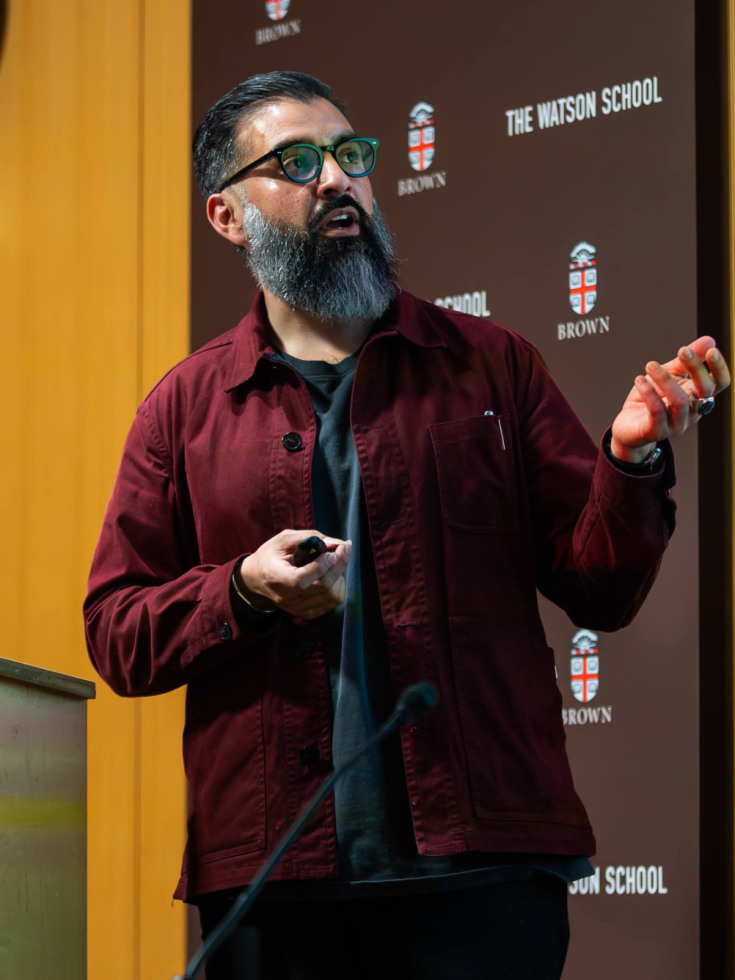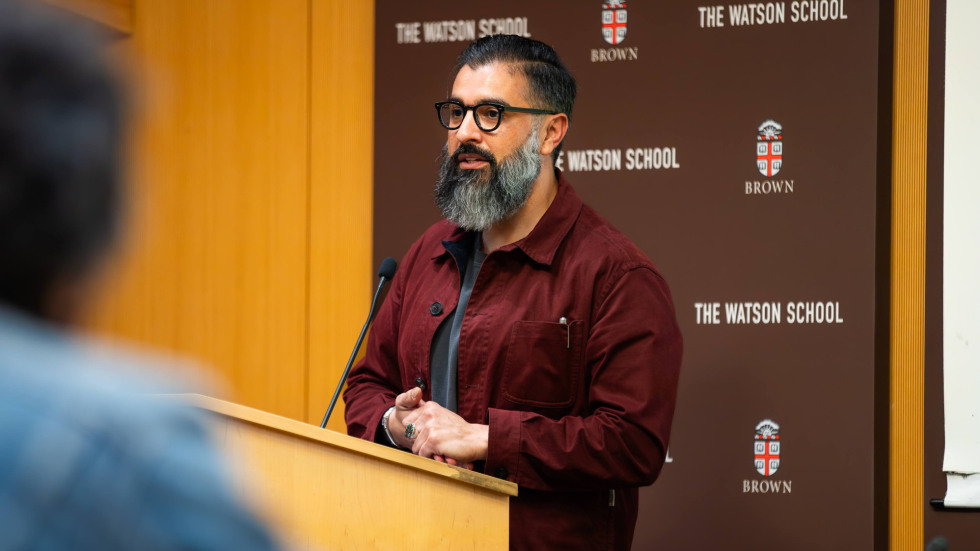
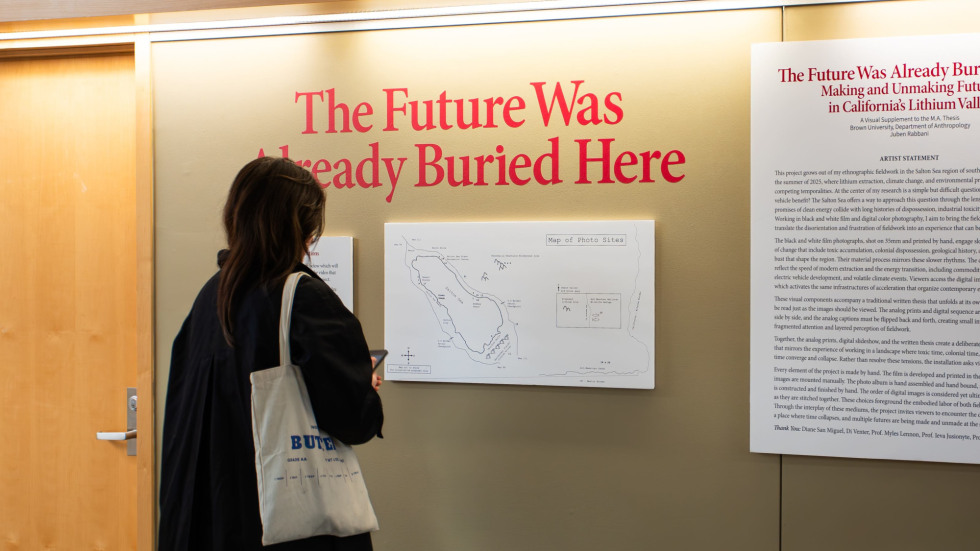
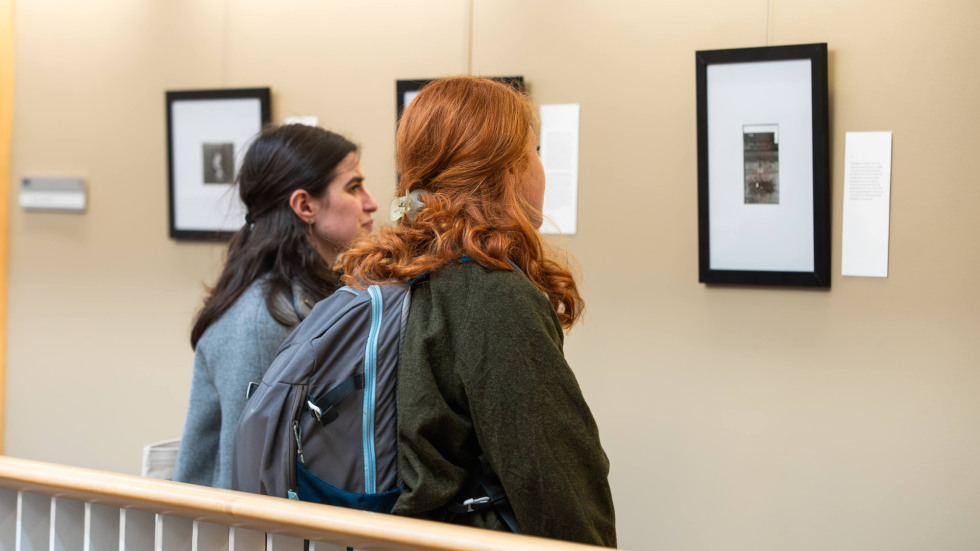
A unique Art at Watson exhibition is currently on display on the second floor of 111 Thayer Street by Watson Ph.D. Fellow Juben Rabbani. “The Future Was Already Buried Here: Making and Unmaking Futures in California’s Lithium Valley” is a multimedia exhibition that chronicles the complicated history of the Salton Sea region in southeastern California.
Beyond being an art exhibition, the project was also submitted in partial fulfillment of Rabbani’s master’s in anthropology in the form of a handmade book of black-and-white photography, and, said Rabbani, “serves as a visual supplement to my broader ethnographic work on the energy transition, lithium extraction and environmental change in California’s Salton Sea region.”
Project manager Pete Bilderback noted that the Art at Watson committee was particularly excited to receive a submission so closely aligned with the School’s mission. “While most of our exhibitions relate to research being carried out at the school to one degree or another, this exhibition displays Watson research directly,” he said.
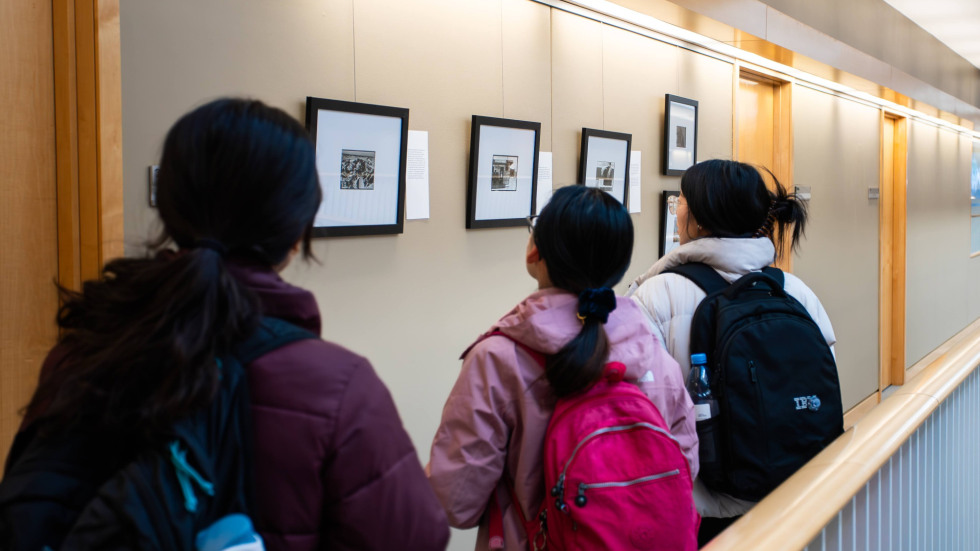
The exhibition consists of black-and-white photographs that Rabbani shot on 35 mm film and printed by hand, which show various locales around the Salton Sea region, an area that has fallen on hard times. It also features a QR code that links to a YouTube video featuring a sequence of rapidly changing digital color photographs of the region. Viewers are invited to divide their attention between the black-and-white photographs on the wall and the color photographs on their devices as they view the exhibition.
The contrast is purposeful. “Each medium was chosen for its temporal resonance,” said Rabbani.
Rabbani said he hoped the black-and-white images mounted on the wall would evoke slower timescales, such as geologic time, which has progressed slowly over 4.54 billion years. “The analog set of photographs, shot on film and printed in the darkroom, attempts to capture toxic timescales, geological time, colonial time and boom-bust eras,” he said.
The rapid sequence of digital photographs, by contrast, “reflects the accelerated pace of capitalism — the cycles of speculation, production and circulation that surround lithium extraction,” he said.
Covering approximately 350 square miles, the Salton Sea is California’s largest lake. It is not a natural formation: it was accidentally created in the early part of the 20th century when the Colorado River flooded, breaching irrigation canals and inundating the basin.
In the 1950s and 1960s, the Salton Sea was a popular resort area, dubbed the “California Riviera.” Exclusive venues like the North Shore Beach and Yacht Club attracted high-profile celebrity visitors, including Frank Sinatra, The Beach Boys and others.
Over time, agricultural runoff and increasing salinity due to evaporation made the lake toxic, resulting in massive fish and bird die-offs. As the water receded, it exposed toxic dust that now plagues the area.
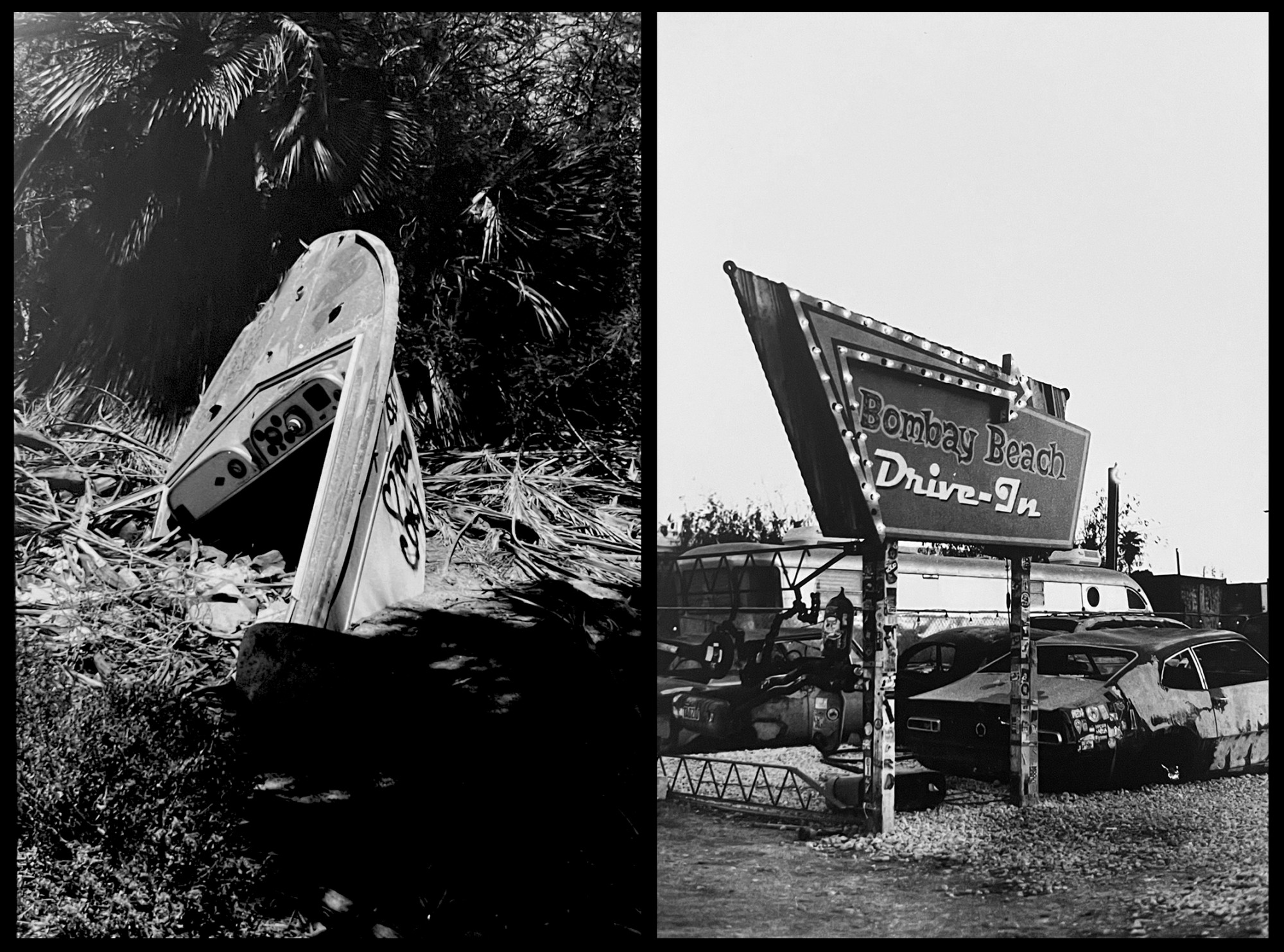
Today, only ghostly traces of its golden age remain; Rabbani’s stark black-and-white photographs document the carnage in a region that at times resembles a post-apocalyptic wasteland. In one photograph, a wrecked powerboat, partly buried in refuse, evokes long-ago pleasant days spent on water that has now receded. In another, a drive-in movie theater with a rusting marquee serves as a home to abandoned, decaying automobiles.
The automobile is central to the Salton Sea’s story and perhaps contains the key to the region’s future. The area contains one of the world’s largest lithium deposits, a mineral critical to the transition to electric vehicles (EVs), which led California Governor Gavin Newsom to lend it a new nickname, the “Saudi Arabia of Lithium.”
After being nearly abandoned for years, increased demand for lithium has brought renewed attention — and investment — to the region. Companies like Berkshire Hathaway have devised methods to extract the valuable mineral from geothermal brine buried a mile deep, and hope to begin extraction as early as 2027, though to date, no lithium has been extracted from the region.
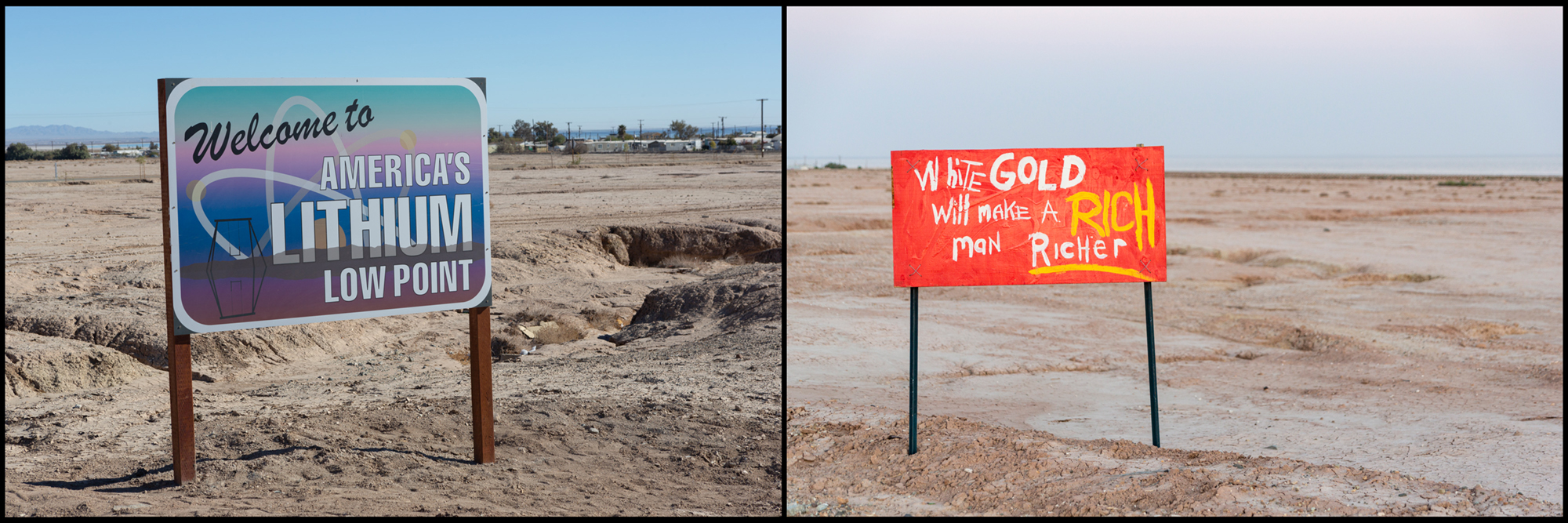
While his black-and-white photographs document what remains of the region’s past, Rabbani’s digital color photographs document the present and what is likely to come in the future. These photos are dominated by images of modern industry, including the lithium extraction facilities on which many are pinning the region's future economic hopes.
The question that Rabbani wants the viewer to consider, and that is central to his research, is: “Who does the EV transition benefit?”
The color photographs present different, opposing answers. One features a sign, professionally printed in a familiar corporate style, that reads “Welcome to America’s Lithium Low Point,” presumably a reference to the region’s altitude, the second lowest in the United States, behind only Death Valley. Another, handmade, sign reads “White GOLD Will Make A RICH Man Richer,” in a sloppy scrawl. One sign points to a brighter future for the region through emerging technology, the other warns that, without checks on capitalism, the future will look much like the present, if not worse.
Rabbani is perhaps uniquely qualified to explore these issues. In addition to his academic qualifications, which include a bachelor's degree in anthropology from UCLA and a master's from the University of Chicago, for ten years Rabbani worked for JD Power, the data and analytics powerhouse, as a consultant to the automotive industry on the EV transition, before returning to academia at Brown to earn his Ph.D.
While at JD Power, Rabbani said he worked on all phases of vehicle development. “At each phase of development from clay models, through various prototypes, to the finished product, I used the consumer data collected by JD Power,” said Rabbani.