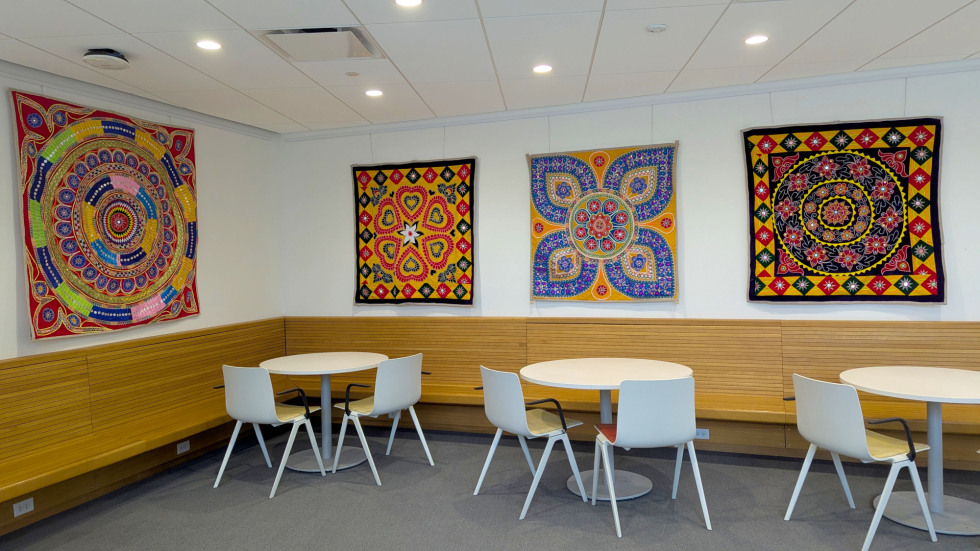
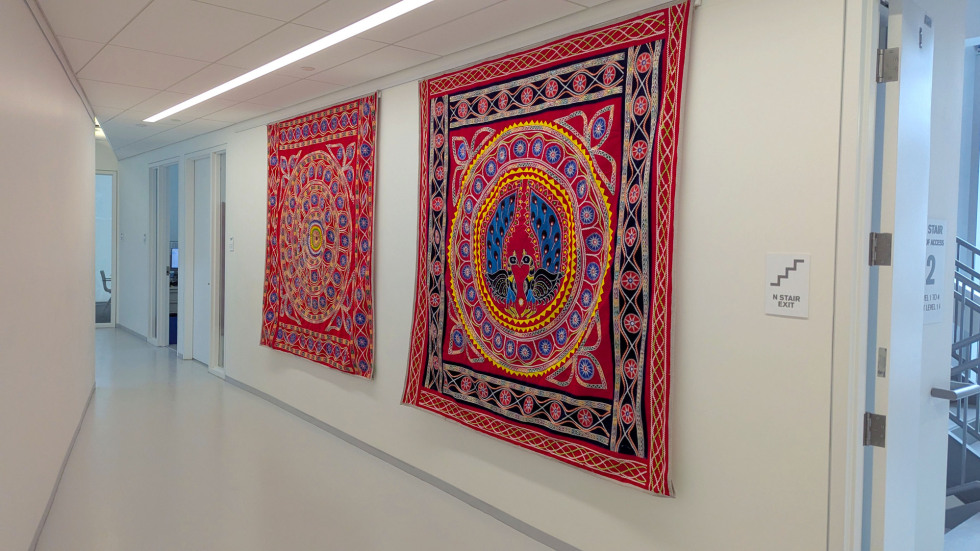
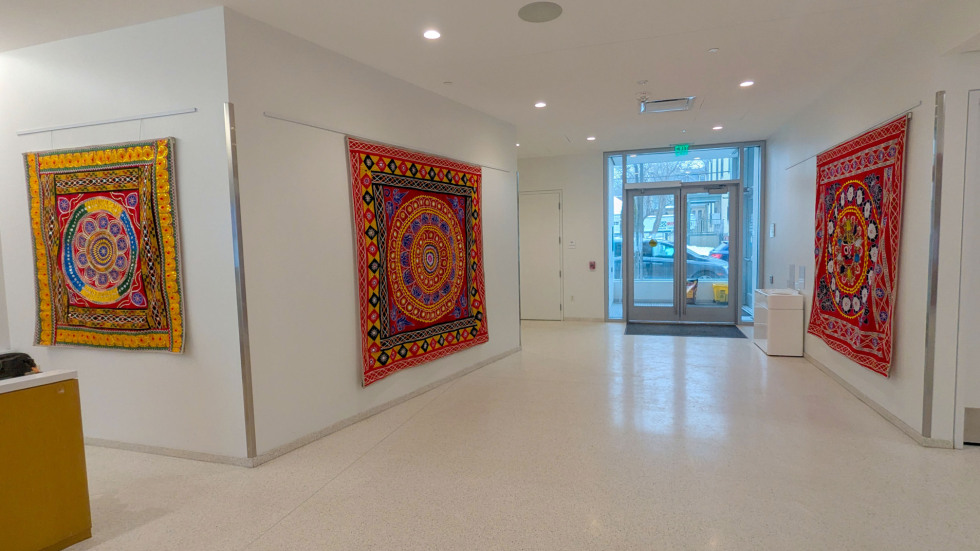
Walking into Stephen Robert '62 Hall at 280 Brook Street, the first thing one notices about “Odisha Illuminated: A Celebration of Ritual in a Modern World,” the latest exhibition from Art at Watson, is the color. Brilliant hues of red, yellow, blue, green and purple emanate from the textile appliqués that currently adorn the building’s white walls.
The space has served as a canvas for many of Art at Watson’s thought-provoking exhibitions in the past, but never more radiantly than in this exhibition of striking handwoven panels made in Odisha, a coastal region in eastern India along the Bay of Bengal, where textile traditions remain deeply embedded in modern life. The exhibition, curated by Odisha native Rakhi Jain, opens on Wednesday, March 4, and will run through the spring semester.
Jain, currently a senior at Phillips Academy in Andover, Massachusetts, said that, by bringing the work of these mostly female artists to the Watson School, she hopes to demonstrate that the traditional arts of her home country are not “relics.”
Jain noted that the traditional techniques used to create these textiles have been passed down from mother to daughter over centuries. “These works are vivid, ongoing expressions of identity, place and memory,” she said. “This exhibition demonstrates the deep visual heritage of Odisha, and each object reflects generations of accumulated skill and intention.”
The intricate, handmade nature of these works is also a salve for those seeking refuge from the current ubiquity of AI-generated imagery.
At a time when some argue that AI will eliminate the need for human creativity and artistry, “Odisha Illuminated” insists on the primacy of the human hand. In place of machine learning models that analyze millions of images to quickly generate new ones, the exhibition foregrounds the specificity of place and traditional knowledge passed down through direct human contact.
“In an increasingly digital world,” said Jain, “this kind of art becomes profoundly vital. We are surrounded by fast images and constant stimulation; these pieces remind us of the value of slowness, attention and the handmade. They ask us to notice detail, repetition, authenticity and beauty that comes from labor rooted in tradition.”
Jo-Anne Hart, Art at Watson’s committee co-chair and exhibition co-coordinator, said the committee “has long been interested in exhibiting textiles,” and “was immediately attracted to the bold colors and the visual storytelling in these exquisite appliqué panels.”
Exhibition co-coordinator Daniel Farber Huang praised the show’s ability to transport the viewer beyond their daily experiences. “This exhibition reveals the world as expansive and richly layered, shaped by traditions, labor and lived experience that reach far beyond our immediate horizons,” he said. “It calls us to slow our gaze, step outside the tempo of everyday life, and reengage with the depth and possibility that persist across cultures and generations.
