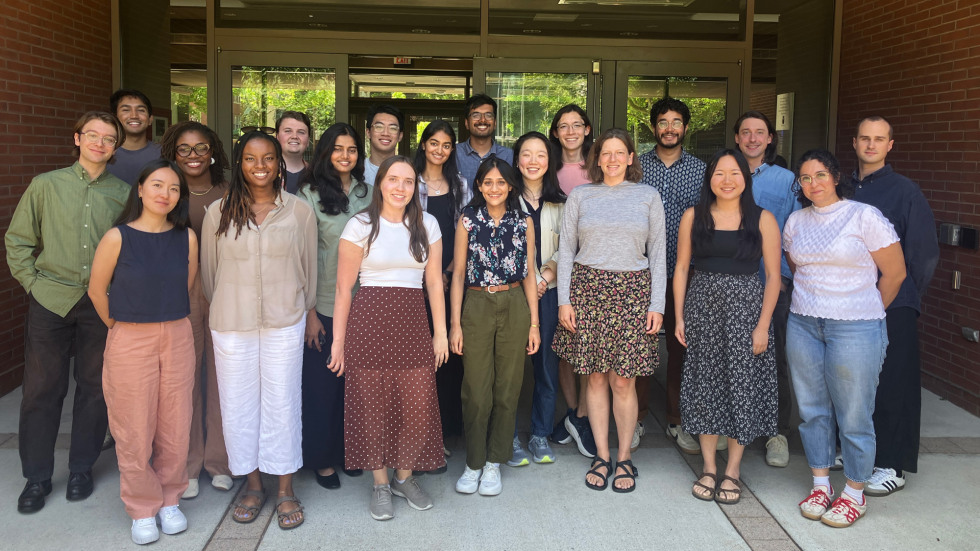
On the first day of the course, Booth gave an overview of AI policy, what is happening in the current administration, and various bills proposed in Congress. Over the course of the week, the students heard presentations from some of the top AI experts at Brown, including Associate Provost for Artificial Intelligence Michael Littman, CNTR Director Suresh Venkatasubramanian, Assistant Professor of Computer Science & Data Science Diana Freed and Watson School Dean John N. Friedman.
Other presenters included a notable lineup of AI policy experts from various disciplines. Among them were Sue Helper, a professor of economics at Case Western University; Miranda Bogen, the chief technologist at the AI Governance Lab at the Center for Democracy & Technology; and Deirdre Mulligan, a professor at the School of Information at the University of California, Berkeley; among others.
Booth noted the lectures covered a wide range of topics. “Michael Littman told us about his experience with the National Science Foundation, how it is structured, and how DOGE has affected it,” she said. “Diana Freed, who researches domestic violence, talked about AI and sextortion and some of the policy interventions she has worked on. Deirdre Mulligan, who flew in from Berkeley, talked to us about her time as principal deputy U.S. chief technology officer at the White House Office of Science and Technology Policy and as director of the National Artificial Intelligence Initiative Office (NAIIO) in the Biden-Harris Administration,” Booth added.
Booth said the program drew students from universities across the U.S., including the University of California, San Diego; the University of Washington; UC Berkeley; the University of Colorado; MIT; Duke University; Carnegie Mellon University; as well as two graduate students from Brown University.
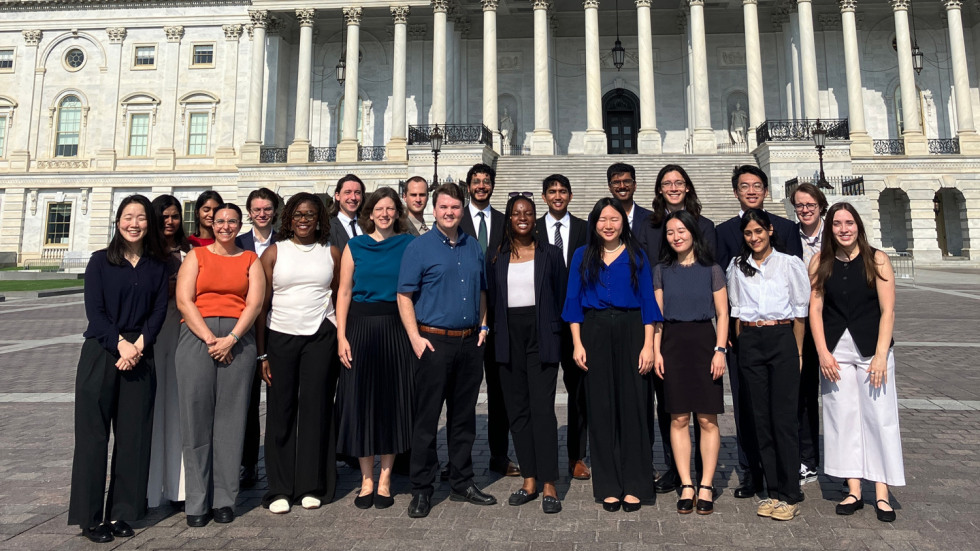
After a week of intensive study at Brown, the students headed to Washington, D.C., to meet with the people who will be making and implementing AI policy: members of Congress and officials from various executive agencies.
Booth explained, “The way this piece of the program works is that students are also constituents. They’re all domestic students, so each has a representative and two senators who represent them in Congress. They ask to meet with their representatives, and usually they oblige.”
Booth said most students attend around four meetings while in D.C. In addition to their own representatives, they might meet with legislators who have a particular interest in AI policy. “For example, Martin Heinrich, a senator from New Mexico, does a lot of work in this area, and his office might be interested in meeting with a group of students,” she said.
President Trump came into office following the 2024 election promising a laissez-faire approach to AI policy, arguing it would encourage AI innovation. However, Booth observed that mounting public backlash has sparked renewed interest in regulation within Washington. “We are starting to see bipartisan regulation efforts emerge,” she said. Booth further noted that the Trump administration has retreated from its initial push for deregulation, issuing an executive order proposing voluntary pre-deployment testing, which would allow the government to evaluate new models before public release.
“The question,” Booth said, “is how do we channel AI productively? How do we build something that supports human flourishing? That’s my objective in participating in the development of systems, beyond just raw intellectual curiosity.”
“I’m not fully optimistic about how AI will develop,” said Booth, “but I’m not fully cynical either. A lot depends on whether we get early attempts to regulate this technology right — hence, the importance of the summer school.”