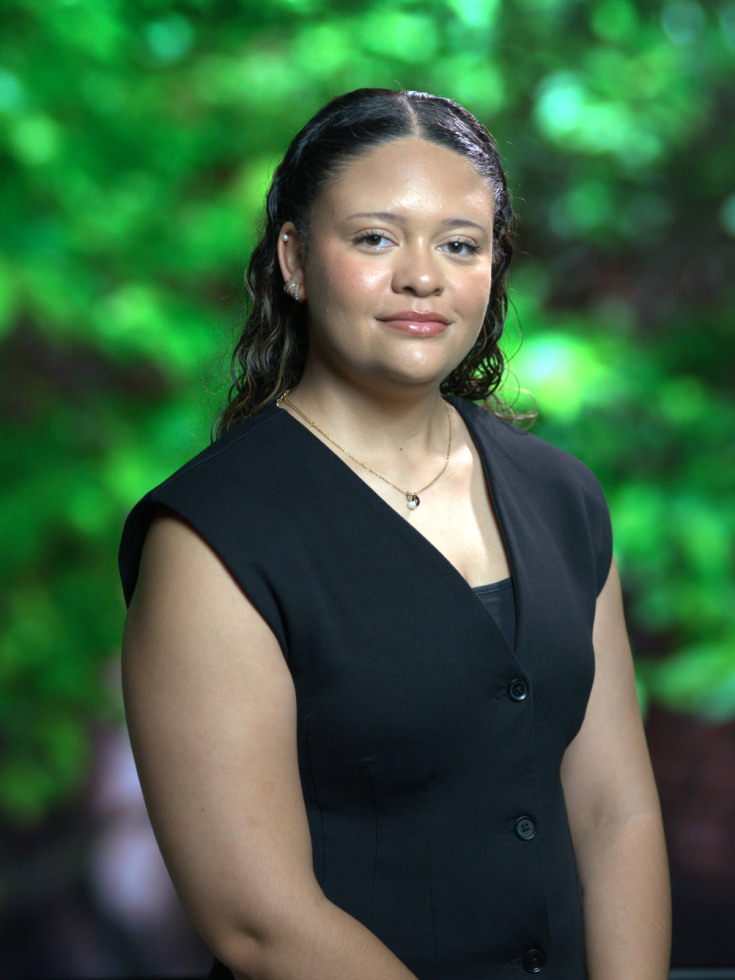
On a cold New England morning, Olivia Hayes sat, centered and calm, in a sunlit room, joking about her Southern accent. “I don’t hear it,” she said. “But I’m told it’s there.”
Hayes grew up in Charlotte, North Carolina. Moving to Providence to attend Brown University was her first time up North. She grew up in a multiracial household where conversations about identity took place at the dinner table, in the questions people asked, and in the quiet negotiations of belonging. “Even down to the simplest thing of ‘What box do I check?’ It’s always been in the background,” she said.
She attended Appalachian State University for her undergraduate degree, pursuing sociology with a concentration in social inequalities. Until her junior year, she believed her future lay in the world of special-needs advocacy. She had spent more than a decade working in the nonprofit sector with children and adults with disabilities and fully expected to continue that path professionally. “I was dead set on it,” she said, “Then a lightbulb went off.”
In a political sociology course, her professor described her own path to policy advocacy, sketching the long arc from community-level care to structural-level change. “I thought, ‘That’s it. That’s what I want to do,’” said Hayes. “When it comes to inequalities between racial groups and gender and disabilities, long-lasting change comes at the policy level. That’s when I hit the ground running.”
Her professor became a mentor, and together they discussed the pathways that would lead from sociology to public policy. Her mentor had attended Brown, and the idea of applying to Brown’s Master of Public Affairs (MPA) program took root. Hayes applied to five public policy programs in total, but the choice came down to two schools. Then her father asked a single question: “How many people get a seat at the table at an Ivy League?”
The conversation prompted her to reflect on her background and the opportunity before her. It was a reminder that access to spaces like this is still limited for many.
Providence, to her surprise, felt like the right fit too. “It’s my first time up North,” she said. “I grew up in a big city but went to undergrad in a small mountain town. I like a small community vibe, and that’s what I found here in Providence.”
Watson’s MPA program is known for its immersion in evidence-based policymaking and applied learning, and Hayes arrived ready for that approach. Her undergraduate capstone, an applied sociology project, placed her on a team working with the town of Boone, North Carolina, to design long-term development plans. The experience stitched classroom theory to real-world consequences, and Hayes carried that clarity with her into graduate school.
At Brown, she stepped straight into fieldwork. As a research assistant with the Realizing Rights Lab, she conducts interviews with teaching assistants and teachers about tutoring programs and the unequal terrain students navigate. She is currently working on her Policy-in-Action project with the Providence City Council, focusing on rental housing agreements — an issue that sits at the intersection of race, class and access.
Her Race and Public Policy seminar has been especially seismic — a course that examines the way policies gain power not only through what they say but how they are enacted, interpreted or subtly retooled to maintain inequity. “I’m diving deeper into the inequalities that I have either faced firsthand or I have seen my dad experience, and it has really opened my eyes to the ways that policy can either alleviate or create divides.”
Hayes discussed the tension between including race in policy to promote equitable outcomes and the risk that the same data could later be weaponized against minority communities. “It’s an internal battle,” she said. “Which way do we go? What moves progress forward without putting communities at risk? It’s a balance.”