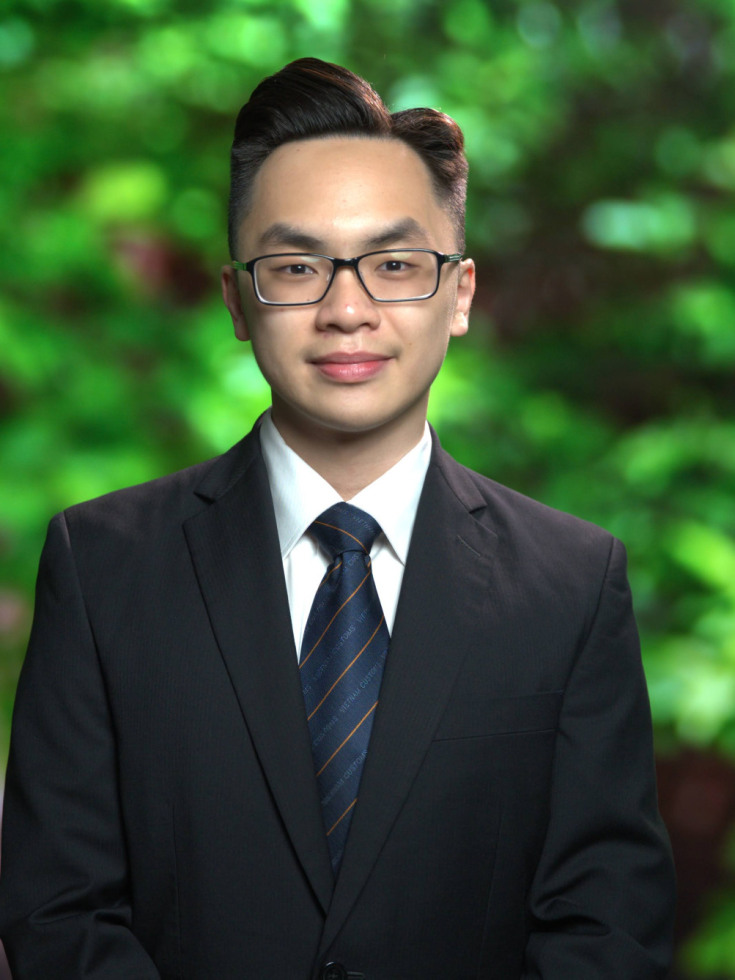
Because of the accelerated, interdisciplinary design of the Watson School's MPA program at Brown, Hoang found an environment that met his expectations and stretched him in unexpected directions. He said he was also eager to learn from the “many well-known and multidisciplinary professors” associated with the Watson School.
Hoang said she was particularly interested in taking classes with Eric Patashnik, director of the Taubman Center for American Politics and Policy. “When applying to Brown, I wrote about [Patashnik] in my personal statement, about how I really admire his work,” Hoang said. “He is very experienced not only in delivering concepts but also in applying them in the real world. I have been very fortunate to be in one of his classes.”
Another key influence has been Andrew Schrank, a professor of sociology who teaches a course on industrial policy. “I didn’t really know about this topic, but he inspires me — not only about industrial policy, but in general, how to apply policy in the real world. He always tries to generalize the lessons so we are not stuck on paper. We can apply the skills and lessons he teaches to our own lives.”
Real-world grounding is central to Hoang’s philosophy of governance. Eventually, he thinks he may choose a career in environmental or education policy, but only after he builds a holistic understanding of the landscape. “Public policy,” he said, “is about finding systematic ways to tackle public problems.”
To illustrate, he points to a topic close to home: climate vulnerability in Vietnam.
“Vietnam is very exposed to hurricanes and floods. Sometimes the government response is just to move people after the storm. But the people have already suffered. Their approach is not systematic enough. I look for public policy to help build systems, not just react,” said Hoang.
One of the most defining experiences of Hoang’s time at Watson has been his MPA Research Fellowship. He was placed on a team working to improve indoor air quality in Rhode Island public schools. “I was very fortunate,” he said, “The project matches my interests.”
The research team is interdisciplinary, including faculty from the Department of Earth, Environmental & Planetary Sciences, members of the Pandemic Center at the School of Public Health, the CEO of the American Asthma Foundation, and representatives from the Rhode Island Departments of Education and Health. The group’s goal is to reintroduce a legislative bill aimed at improving air quality in Rhode Island public schools during the 2026 state legislative session.
“They introduced the bill in 2025,” said Hoang, “but it didn’t pass. I joined the team to help with the reintroduction.”
He expected substantive revisions to the bill. Instead, he found himself in a crash course on advocacy.
“They’re not changing the bill,” he said. “That was a big surprise for me. They think the problem lies with advocacy. They’re focusing on gathering different stakeholders, communities and legislators. One of my projects right now is to organize a convening for everyone to join so we can build momentum.”
For Hoang, this was his first encounter with political advocacy.
“I haven’t really dealt with advocacy before,” he said. “We have a different political system and a different lobbying style in Vietnam. Being involved in one of these new areas is fascinating.”
Ask Hoang what he loves most about life at Brown, and he is quick to mention the closeness of the community.
“My undergraduate program was really large, but at Brown, my master’s program cohort is very small — everyone knows one another. I have the opportunity to be friends with classmates my age, with classmates who have more experience, and with classmates who have different experiences and backgrounds. I have learned a lot from them.”
Hoang also serves as co-chair of the MPA Student Advisory Group, a bridge between faculty, staff and students.
“It’s made me more mature,” he said. “My role is to communicate and connect people. There have been many chances for me to talk to different people and learn about different backgrounds and perspectives, and to see how diverse my community is.”
This semester, Hoang has been placed with an international nonprofit focused on menstrual hygiene for schoolgirls in India for his Policy-in-Action Project. “Public health isn’t really my strength,” he admitted. “But I’m looking forward to learning from the organization and from my classmates.”
One throughline in Hoang’s path from Hanoi to Providence is his dedication to understanding the intricacies of different systems by developing skills, building relationships and learning from diverse perspectives so he can one day help improve and strengthen them.
“Vietnam is a country with a lot of areas that need development,” he said. “I don’t have a specific policy area I am focusing on right now. I want to start with a comprehensive view of policies first.”